The first blog is always the most difficult, you never know what to say and write. So like most people, what did I do?
I Googled it.
From listing out all the different media platforms and applications I use and circling the ones I use everyday made me realise that there are so many different sources of media out there that we use on a regular basis.
While it occurred to me that I use the likes of Facebook and Instagram typically everyday, I didn’t occur to me that Google was included. Spotify was included. Even Microsoft Word was included! We have all these media applications and platform all around us, it would be more of a challenge not to use them. In fact, we rely on them a lot in our lives.
Yes there used to be other ways to do the things that we now use media for, such as things as simple as talking to one another, but now we have the option to do this in so many different way; call, text, email, snap, video chat, the list goes on…
And the amazing part is, the conversation can be totally different depending how you decide to communicate to somebody (no wonder so many texts/messages are misinterpreted these days).
Language and New Media is already opening my eyes, so this blog really is going to be interesting to write over the next few weeks.
At the moment, the majority of people are in a state of frenzy due to the rapid and drastic progression of the Coronavirus, from panic shopping to schools closing down, everything is chaos. But how different would this state of national emergency be if it wasn’t for the influence of technology?
It has only been a few days of being at home after the university stopped face-to-face lectures, but we have already adjusted to this new way of doing our normal daily routine but from the safety of our homes.
Through the use of technology, we have been able to have lectures online with our professors as if we were actually in the classroom. Okay, yes you might spend the first 10/20 minutes making sure that everyone is able to hear and the occasional technical issue, but we’re all adjusting!
Social distancing because of the Coronavirus has really helped push people into the 21st century. Whether this be encouraging people to work from home, moving exams online or doing contact-less deliveries, by using technology to support one another has really helped everyone continue as normal as possible during this difficult time.
It is amazing to see the amount of emails, posts on social media and news stories about members of the public helping one another out to help protect the vulnerable during this anxious period. I have seen people offering to go shopping for those who are self-isolating, companies going above and beyond by making sure they have enough stock on the shelves, teachers preparing weeks worth of school work in just a couple of days for hundreds of children to do at home. While it might not seem like it at the moment, technology really has made the past few weeks run smoother than it would’ve done if this had happened 50 years ago.
I’m going to finish this blog with another thing that has sparked up on the internet over the past few days, which I found particularly enjoyable, is the ‘toilet roll challenge’ (and no it’s not a challenge as to who can find a single roll of toilet roll in the supermarket!) As a way to keep themselves entertained during self-isolation, many celebrities, particularly sports stars, have taken up the challenge to do kick-ups with toilet rolls, sharing their video on social media and nominating others to take part (also know as the ’10 touch challenge’ or ‘stay at home challenge’). As many people continue to accept their nomination and take part, the challenge is becoming just as viral as Covid-19!
Comment below with your thoughts and let me know if you have spotted anything over the past couple of weeks which would have been completely different if it wasn’t for technology.
Stay safe!
Update 28/03/2020: After two weeks of being in self-isolation, I have seen a rise of many different challenges going viral on social media that people have started doing to keep themselves entertained. For example, somone posts an embarrassing image of themselves on Instgram with the comment “Until tomorrow”. Anybody that likes this post will be sent a message saying they have carry on the trend and post their most embarrassing picture. Another challenge that has appeared which is my personal favourite is the baby face challenge where people are posting baby pictures of themselves and nominating others to do the same thing.
The number of challenges that are circling at the moment just goes to show how people have turned to social media in a time of boredom when they are not allowed to leave the house. What would we do without the internet and social media?
Online social networks are a crazy thing. Most people will add the usual family, friends from school, friends from work, their neighbours, etc. on their social media accounts, but it is scary the amount of people that would add someone on, for example, Facebook that they have only just met or even somebody that they haven’t even met at all.
Lets continue using Facebook as an example. The average number of friends that people have on Facebook is around 130, but how many of these people are actually classed as “friends?”
The image seen when you first sign in or create an account on Facebook.
Ever since it was created by Mark Zuckerberg in 2004, Facebook has been a great way to stay in contact with everyone you know (including friends and family). I mean what better way to share news than through a platform that has the majority of people you know on it and even those who don’t have Facebook would be told by someone who does! You can stay in contact with people no matter where you are or what you are doing.
Facebook is also an easy way to keep people within your social network and extend it further, simply because nearly everyone has it! New colleague at work? Add them on Facebook. Met someone at a concert? Add them on Facebook. Found out about a long-lost relative? Add them on Facebook!
Facebook even helps you through this process by suggesting friends that have number of mutual friends with you!
However, a large number of people we have on Facebook are considered more “acquaintances” than actual friends. So why do we have them on Facebook?
Personally, I think a lot of it is down to convenience. Facebook is a really easy way to create groups with people you share something in common with. For example, before I started at university, I (among many people) joined the Reading Freshers page and group chat in order to get to know people before I started university and to find out as much as I could about the uni and all the different events going on. I even found a seperate page and group chat for the halls I was staying in. And now that I am at uni, I have different groups for my courses and modules and the different societies that I am part of.
There are even groups and pages out there for common interests, allowing discussions about things such as music, films and celebrities, connecting you with a wide variety of people with the same interests all over the world!
Previously, before the time of social media, it was more difficult to keep people within your social network. Whereas now, Facebook and other social media pages give us the ability to talk to whoever we want, whenever we want! Plus with the amount of different pages and group chats for everything you can possibly think of, you can expand your social network more than ever before!
Comment below with your thoughts or even an example of where Facebook has allowed you to connect with your social network!
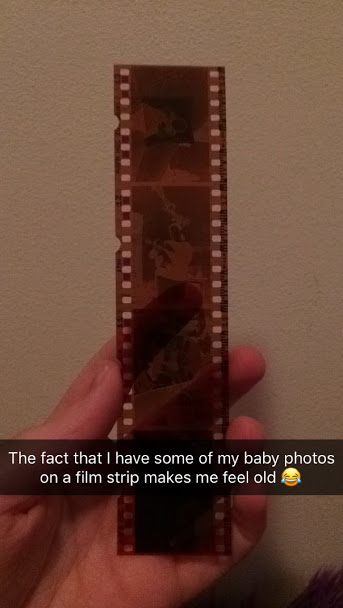
This is a photo I took 3 years ago of a film strip I found with some of my baby photos. The ironic part is that I took this picture on Snapchat, which is evident from the text in the foreground of my photo. In the space of 17 years or less, we have gone from having photos taken using a film strip, to having a camera that we carry round with us 24/7 with various ways to edit the picture that we can see straight away.
The process of taking pictures has changed rapidly over the years due to the influence of technology, starting from things as simple as the quality of the photo itself.
Take a look at the baby pictures of myself and my sisters. It is quite evident that it isn’t just my mum’s photography skills that have improved over the years. The biggest change between these pictures though is the fact that my baby picture is actually a picture taken on a phone of a developed picture from a film strip. Whereas both of my sister’s baby pictures were taken on phones and only phones. Because of this reason, we have so many more baby pictures of my sisters than of me. Simply because it is so much easier to take a picture nowadays.
From left to right: Me (2000), Evelyn (2011) and Robyn (2016)
This easily accessible nature of taking pictures has now developed to the stage we are at today. As one of the most favoured purposes of pictures nowadays, pictures are used to convey a message, whether this be a picture of ourselves with a certain facial expression, or using random pictures as a canvas for our messages, or showing our friends some new clothes we’ve bought or food we’ve just prepared.
But why choose to take these specific pictures?
When pictures are sent as a message, they usually have a hidden indexical meaning behind them that is being conveyed, implying that there is more behind the message than you realise when you first look at it. Everything within that picture will continue to add to the orignal narrative of the message, so much that the picture becomes its own “speech act.”
So next time you receive a picture from a friend (including a Snapchat), have a look at what they have actually taken a picture of. Does it have some kind of hidden meaning or message behind it? What are they trying to infer from that picture? You never know what you might discover.
Reading and writing is one of the first things we learn when we start school, but we are never taught how to communicate online.
My sister is only 8 years old. She’s too young to have a phone and to be going on social media pages like Facebook and Twitter. However, she has already started developing her online writing skills. She only really goes on her iPad to play games and watch YouTube videos, but whenever she sends me an iMessage, it is a different sort of language than what she uses when she speaks or her writing at school. From the over-extensive use of exclamation marks to the animation of the messages, she does it all.
Yet, she has never been taught that. I personally haven’t taught her to message like that and neither have my parents. So where has it come from?
As technology continues to develop and upgrade, we have been given the opportunity to explore our written communication online. Before, all we could do is type a simple message. We even became creative with ways to make our texts shorter and therfore quicker to write.
Whereas now we have so much available to us in order to communicate. For example on Snapchat we can send a snap to our friends by taking a picture of ourselves or something going on around us and add text and/or filters to convey a message. Sometimes we don’t even do that, we just send the picture or video that we have taken.
Another example is GIFs, what better way than to show your reaction to a message than through a GIF! Having a GIF to emphasise how we are feeling is so much easier than attempting to type it, even if it is more dramatic than we would actually be!
My personal favourite is the use of emojis which I find help convey a tone of a message. For example, my friends and family know not to take me seriously if I add a laughing emoji at the end of message, even if I say something that sounds particularly harsh (such as “You’re an idiot!😂”)
Technology has opened up a wide range of ways to communciate to our friends and family online that it has become so natural for us to use. What is your favourite method of communicating online?
You are currently sat here reading this blog post. If you look around wherever you are right now, I bet you could list at least five things that have some sort of language and text on it that requires reading. These were the first five things I spotted when I did the same thing while writing this blog:
Reading is such a necessary part of life nowadays. There is always something around us that requires us to read, whether it is a textbook, a message on our phones, a street sign, a poster on the wall, etc.
Johannes Gutenberg’s Printing Press
Before the invention of the printing press in the 15th century, language for the purpose of reading wasn’t seen necessary or influential like it is today. Stories were passed on from generation to generation. Only the elite were considered important enough to have a proper book of the Bible becuase they took so long to write. A large percentage of the population couldn’t even read.
Look where we are now though; Words are everywhere, in all different forms.
It’s not just books anymore, it is products and clothes and decorations.
We use words for advertising and aesthetics.
The development of technology from the printing press has really changed how and where we read. We have so much technology nowadays that people don’t even realise they are reading half of the time when they are physically looking at words and reading them.
For example, I find it hilarious when people say “I don’t read” or “I don’t like reading.” Yet, five minutes later, they are sat there on their phones, scrolling through their social media pages, READING! We have text on our phones that we read continuously!
It has even gotten to the point that books are no longer required to be printed because we can access e-books on so many different devices. In some cases, we don’t even have to read the book ourselves because we can listen to audio books.
Personally, I don’t like reading E-books or listening to audio books. While it makes it so much easier to access e-books for things like required reading for a module or listening to a book while doing jobs around the house, I find there is nothing better than sitting down with a physical book in my hand when it comes to leisure reading.
The printing press has been developed so much to the point that one day we might not even need to print books at all, making the original press itself pointless. Yet, if it wasn’t for this original invention, we might not have even got to the point where we are reading e-books or listening to audio books.
What do you think? Comment below and let me know your thoughts.
It is scary to think how much the internet knows about us. It knows our age, our gender, what we like, what we don’t like, even where we’ve been.
Yet, we let it.
We agree to these cookies that allow pages on the internet to share data based on what we’re looking at just because we want to get rid of the annoying little tab on the top/bottom of our screen (I even got one when previewing this blog post!).
These cookies provide platforms, such as Google, with so much data about us, that it can literally predict what we want to read. They allow search engines like Google to tailor our web searches to us, filtering out all the pages that it thinks that we don’t want to see.
How are we supposed to explore what’s out there on the internet if it continues to tell us what we already think?
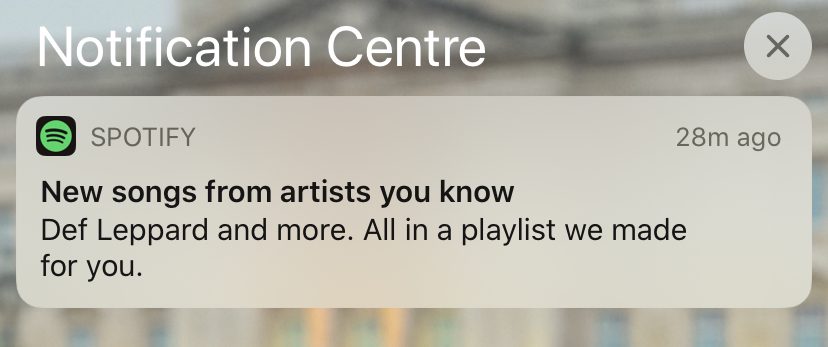
However, I can’t complain too much. In some ways, it does have its advantages. Like on Spotify, when I get bored of listening to the same playlist over and over again, I have a custom made playlist full of new and different songs based on what I have previously listened to. It even tells me when my favourite artists have released new songs!
Feel free to have a listen of my most recent Spotify ‘Release Radar’ notification.
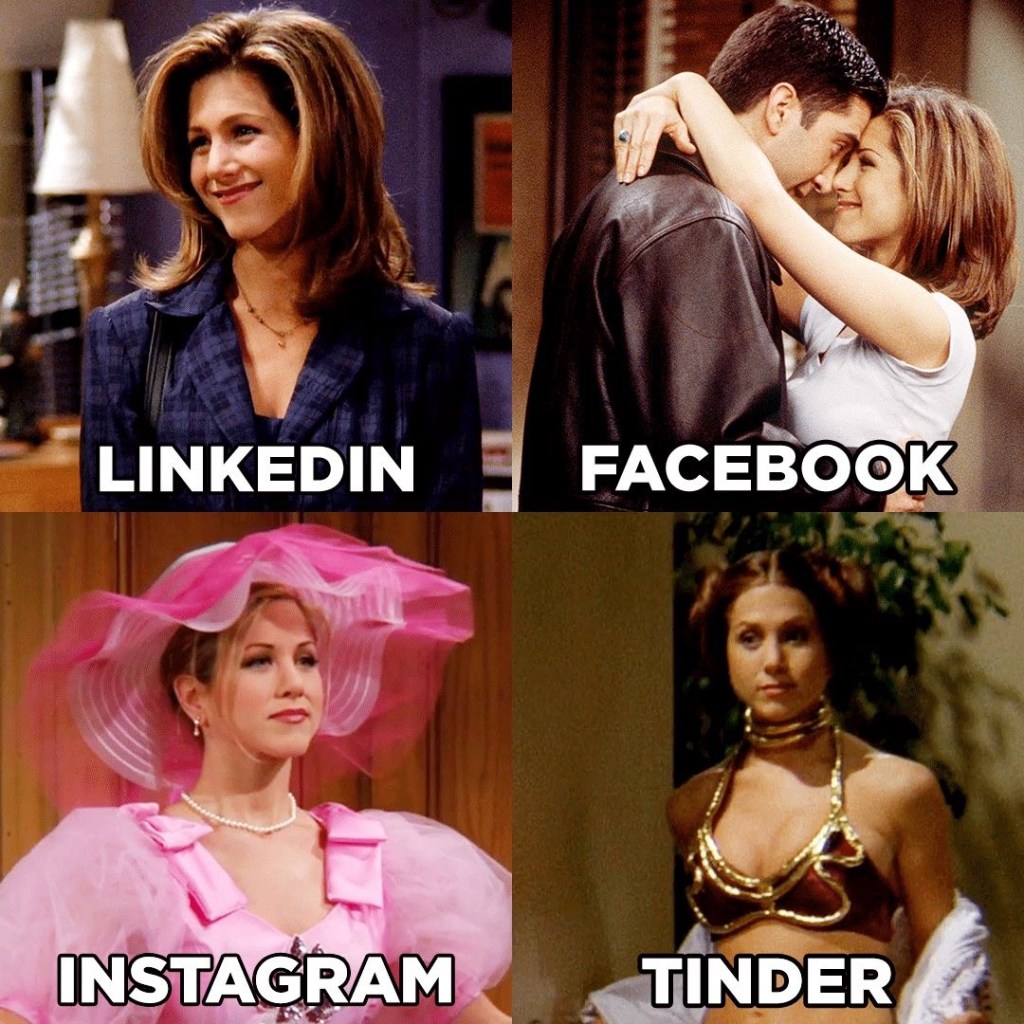
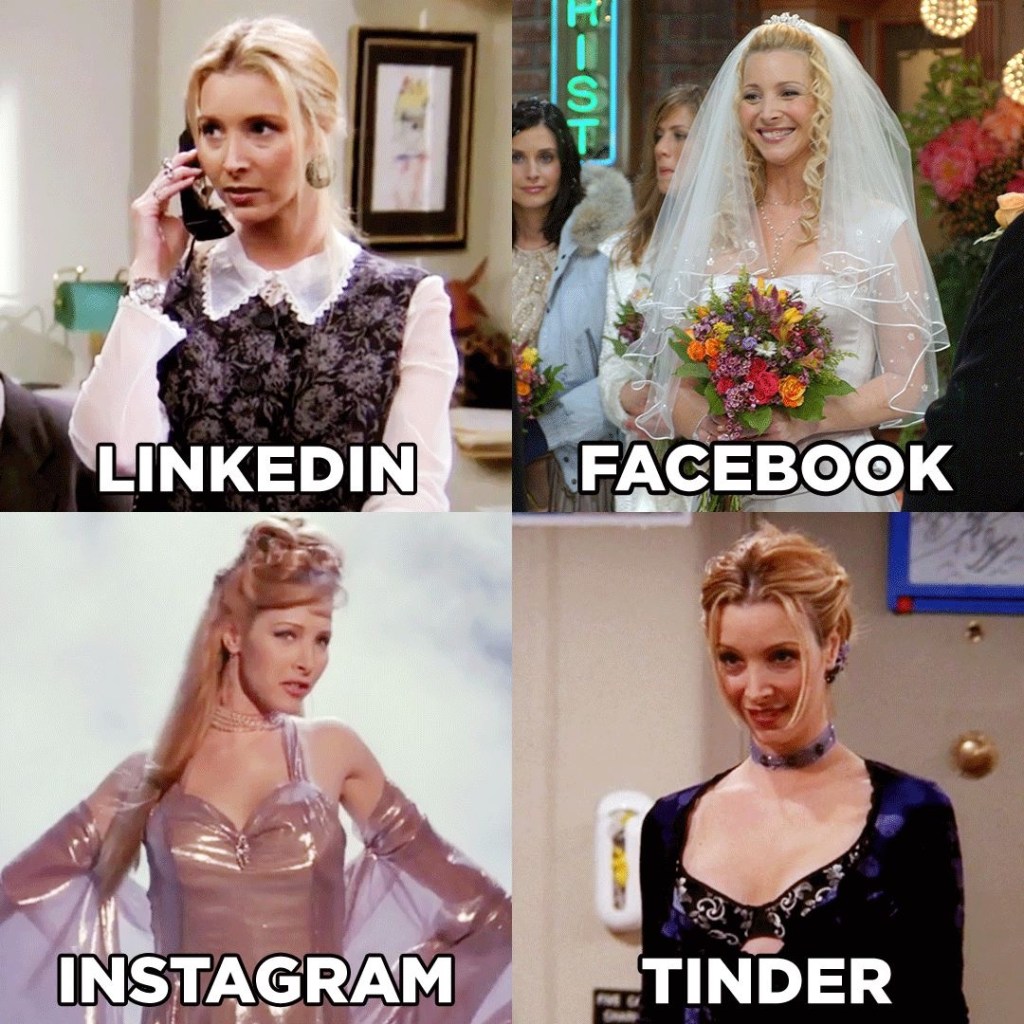
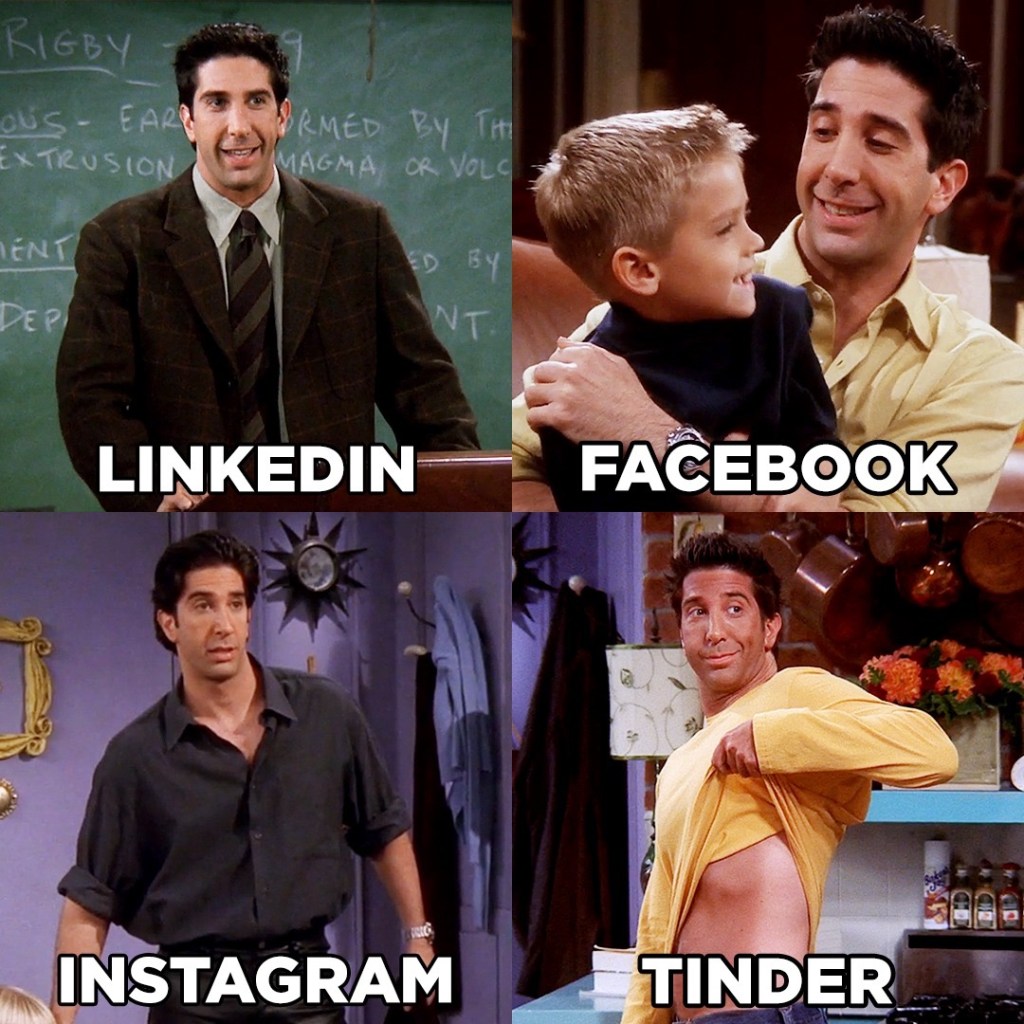
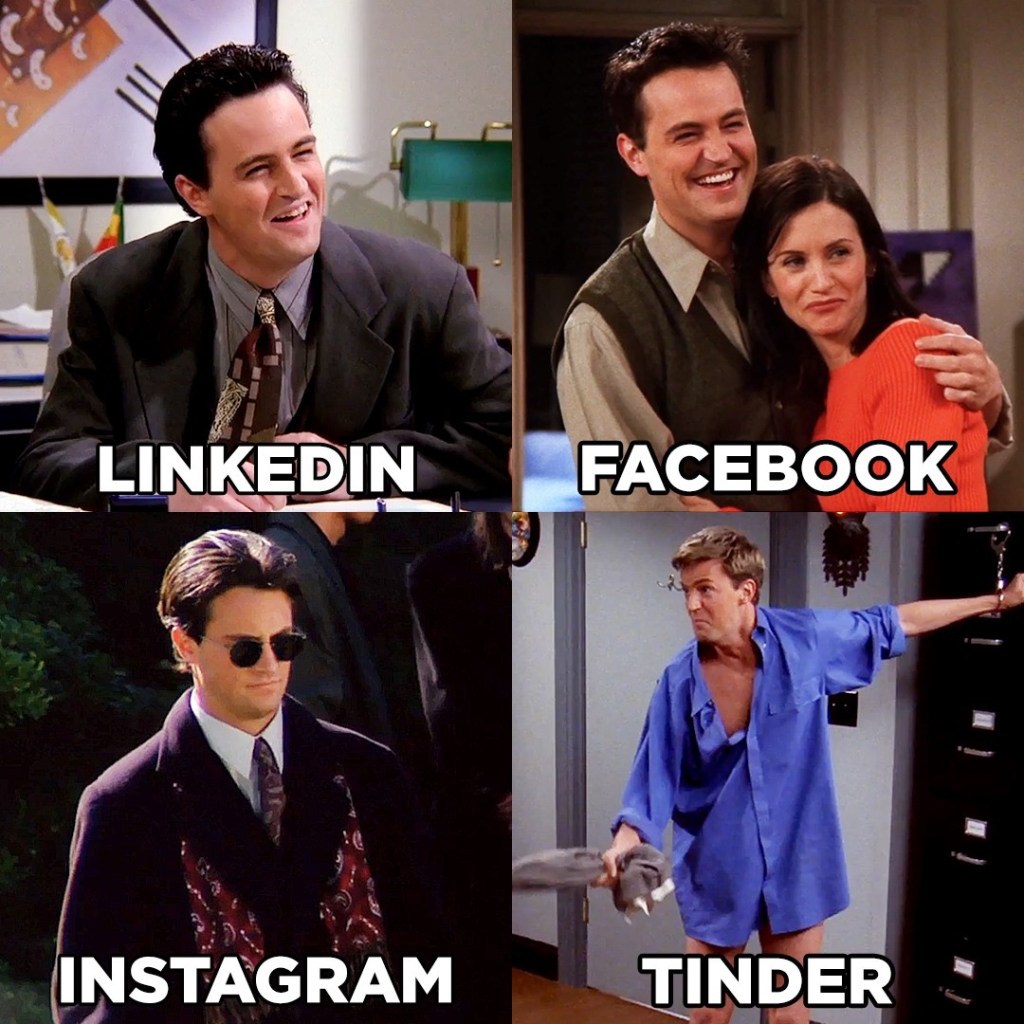
While scrolling on Facebook this morning, I came across these images posted by one of the pages that I follow:
For those of you who don’t know, these are characters from the popular TV comedy sitcom, Friends (my favourite TV show of all time). The show was on air between 1994 – 2004, a time before these media platforms became popular or even existed (LinkedIn, 2003; Facebook, 2004; Instagram, 2010; Tinder 2012). Therefore, it is no suprise that they are not mentioned within the show.
However, fans have collated pictures of each of the characters, reflecting images that would represent them in each of these media platforms. This highlights how there are different attributes that people associate with each of the different platforms depending on how they are used.
LinkedIn – A place for professional networking.
Facebook – A place to share information and images of family and life events.
Instagram – A place to post pictures where you can show off to your internet friends.
Tinder – A place to attract a new date (in other words; a dating tool).
It is because of these different attributes that we reflect different identities online (which can also be seen in the pictures above). No matter what social media platform you use, many people tend to unconsciously change their identity depending on the platform they are using in that specific moment. Whether it is portraying yourself as a professional on LinkedIn or sharing pictures of yourself with your boyfriend/girlfirend on Facebook.
Identities online can vary so much depening on the person and the media platform, but it all comes down to the idea of Audience Design. Everything you post on social media is influenced by your audience. For example, you wouldn’t post a picture of yourself on a night out on your LinkedIn account because it would destroy your professional identity to your current and future colleagues and employers. Instead, you would post your partying pictures on somewhere like your Snapchat story, where your friends can see what you have been up to in the past 24 hours.
I’ve talked a lot here about reflecting your identity through pictures, but the language you use online also changes depending on the social media platform you are using. From putting inspiring quotes in the captions of your Instagram pictures to expressing your opinion on Twitter.
For some people it may be using different languages on their social media because they have friends and family that live in a different country. I’ve seen instances on Facebook where someone has written their status on Facebook twice, once in English and again in another language, allowing them to address both their English audience and foreign audeince.
Identity can be expressed in many way online. Can you think of any examples where you have changed your identity online?
UPDATE (31/01/2020): So over the past week, several of these have popped up on my social media pages. Turns out that is has become a new meme, known as the ‘Dolly Parton Challenge.’


















 MJC Language and New Media Blog